
A Spotlight on the Elusive Clouded Leopard
27 Mar 2026 Alpine Asian Treks
Nepal’s Twelve Wild Cats: A Spotlight on the Elusive Clouded Leopard
Nepal is a haven for wild cats, being home to an incredible 12 species. This group includes four majestic big cats: the Bengal tiger, common leopard, clouded leopard, and snow leopard. The remaining eight are smaller felids, consisting of the fishing cat, leopard cat, Eurasian lynx, Pallas’s cat, jungle cat, Asiatic wildcat, rusty-spotted cat, and marbled cat.
The Bengal tiger (Panthera tigris tigris) is arguably the most graceful and powerful of them all, with a recorded population of over 355 in Nepal. Typically found in tropical climates at elevations between 100 and 1000 meters, they have in recent years been observed at higher altitudes, a shift attributed to the effects of global warming.
Their habitats vary by species. Common leopards are usually found between 1,000 and 2,500 meters. In contrast, the snow leopard roams the stark, rocky terrain and alpine meadows above the treeline, typically between 3,000 and 4,500 meters, moving up to 5,000 meters during the summer.
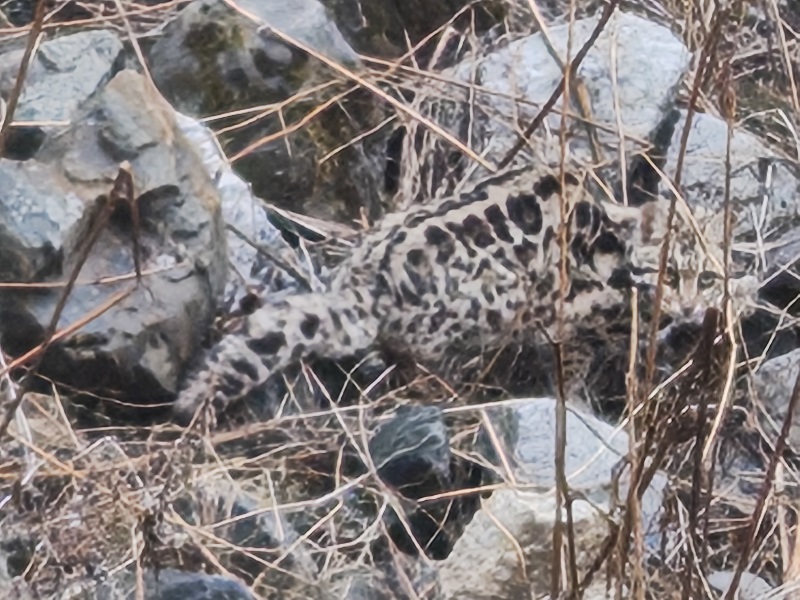
Among these cats, the clouded leopard (Neofelis nebulosa) stands out as one of the most mysterious and elusive. Known locally as धुवाँसे चितुवा (dhuwãse chituwa), it is named for its unique, cloud-like fur pattern—a stark contrast to a tiger’s stripes or a leopard’s spots. This coat provides perfect camouflage in the underbrush of the Himalayan cloud forests. Remarkably, many Nepalis, including villagers living near its habitat, are unaware of its existence.
This endangered species is listed as Vulnerable by the IUCN and protected under CITES Appendix I. It inhabits dense tropical, subtropical, and temperate forests across South and Southeast Asia, ranging from lowland areas up to 3,500 meters. Despite this relatively wide distribution, it remains one of Nepal’s least studied wild cats.
Shy of humans, clouded leopards typically avoid settlements. However, as habitat destruction impacts their natural prey density, they occasionally turn to livestock. Their diet primarily consists of monkeys, deer, pigs, rodents, squirrels, and birds. A remarkable arboreal acrobat, this big cat can even hang upside down beneath large branches, using its large paws and sharp claws to secure a firm grip.
I was fortunate to spot this rare creature myself while trekking to Annapurna Base Camp, in early March 2026, near the village of Deurali at an elevation of approximately 3,200 meters. It was a fleeting encounter with a true ghost of the forest, a reminder of the incredible biodiversity that Nepal has to protect.
Date source from Internet.
Auther: Shekhar Bahadur Thapa